Why Design Intent Needs the Architect During Construction
A custom home can be carefully resolved on paper and still lose its essential qualities through a series of apparently small substitutions during construction. Architect involvement creates the review process that connects those decisions back to the whole house.

The short answer
The architect’s role during construction is to help the owner understand whether field decisions, substitutions and details remain consistent with the approved design. The architect does not replace the contractor, inspector or testing agencies, and the exact scope depends on the agreement. Continued architectural review nevertheless protects spatial relationships, climate strategies, material coherence and the long-term value that can be weakened when each change is considered in isolation.
Key decisions
What to understand first.
- 01
Define the architect’s construction-phase services in the agreement before work begins.
- 02
Submit proposed substitutions with enough information and time for architectural review.
- 03
Treat shading, privacy, openings and envelope details as performance decisions, not decoration.
- 04
Use physical samples and mock-ups to review color, texture, joints and transitions together.
- 05
Record accepted changes in writing and coordinate their effect across all disciplines.
- 06
Maintain a clear approval path among owner, architect and contractor.
- 07
Protect the concept as a whole instead of optimizing isolated products or trades.
A substitution is rarely only a substitution.
Changing one material, window system, screen or lighting component can alter several relationships at once. Color affects reflected light; thickness affects alignments; performance affects comfort; module affects joints; availability may alter sequencing. A product that appears equivalent on a data sheet may not be architecturally equivalent in the room or elevation where it belongs.
The useful question is therefore not simply whether the substitute can be installed. It is whether the change preserves the design criteria established for the whole residence. The architect can compare the proposal with those criteria and explain the consequences so the owner can make an informed decision.
Climate elements are part of the architecture.
In Miami, deep overhangs, vertical fins, screens, protected openings and landscape are not optional styling devices. They can moderate direct sun and glare, improve privacy, shelter thresholds from rain and shape the hours when indoor and outdoor spaces remain comfortable.
Removing or simplifying one of these elements may preserve the broad silhouette while changing how the house performs and feels. Construction review allows the team to test cost or fabrication alternatives without quietly abandoning the environmental logic that generated the design.

Material coherence depends on coordinated decisions.
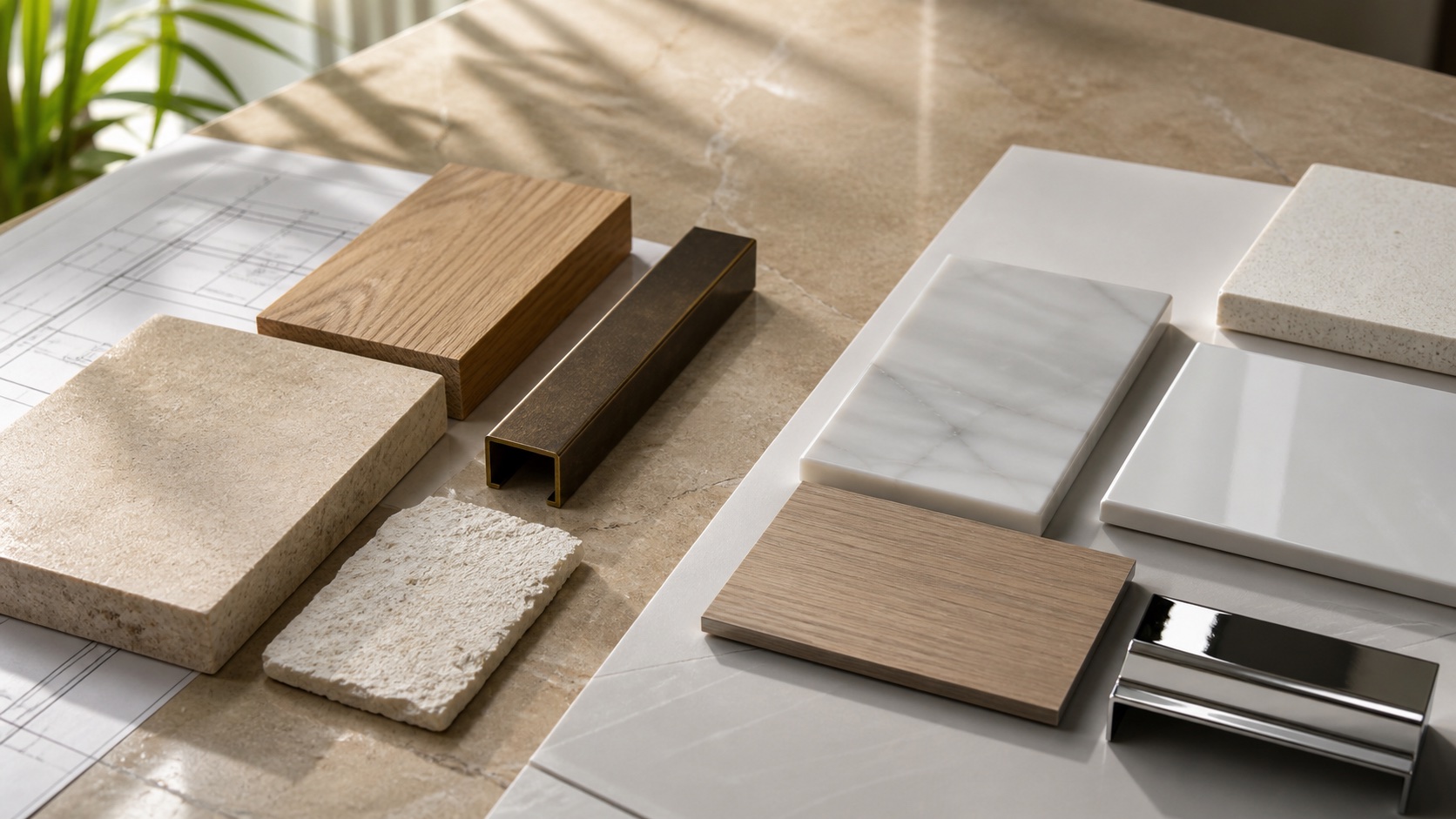
A material palette becomes architecture through proportion, edge, grain, joint, shadow and the way one surface meets another. Those qualities are difficult to protect through disconnected product approvals. A sample should be reviewed beside adjacent materials and, when the decision is significant, at a useful scale and under representative light.
Mock-ups give the owner, architect and contractor a shared reference before repetition makes a problem expensive. They also make expectations visible: the discussion moves from an abstract finish name to the actual relationship the completed work must achieve.

Construction administration creates an informed decision process.
Construction administration is not continuous supervision of the contractor’s means and methods, nor does it guarantee perfect work. Its value is a defined communication and review structure. Depending on the agreement, the architect may visit the site at appropriate intervals, review submittals, respond to requests for information, evaluate substitutions and help determine whether observed work generally conforms to the contract documents.
The contractor remains responsible for construction, sequencing, safety and its contractual obligations; authorities and inspectors retain their own roles. The owner benefits when questions reach the right participant before work proceeds and when accepted changes are recorded rather than improvised.
- Ask what problem the change is intended to solve
- Request performance, dimensional, finish and warranty information
- Review effects on adjacent work and other consultants
- Confirm the owner’s decision in writing
- Update the project record when the change is accepted
The goal is continuity from idea to inhabitation.
A one-of-a-kind residence gains value from the coherence of many decisions rather than from one spectacular object. Architecture, interiors, shade, landscape, systems and craft reinforce one another until the house feels inevitable for its owners and place.
Keeping the architect involved during construction helps that coherence survive real constraints. Alternatives can still be considered, budgets can still be managed and field conditions can still be resolved—but the consequences become visible before the essential qualities of the home are traded away.

Frequently asked
Direct answers.
Does architect involvement during construction replace the contractor?+
No. The contractor remains responsible for construction means, methods, sequencing, safety and its contractual duties. The architect’s services are defined by the owner-architect agreement and generally focus on interpreting the documents, reviewing information and helping the owner evaluate conformance and design consequences.
Can a contractor propose a less expensive material?+
Yes. A proposal can be evaluated for cost, availability, performance, dimensions, appearance, warranty and its effect on adjacent work. The important step is to review the complete consequence before the substitution is approved and installed.
Why are samples and mock-ups important?+
They reveal color, texture, scale, joints, workmanship and transitions that drawings or small product chips cannot fully communicate. They create a shared reference for the owner, architect and contractor.
When should construction-phase services be agreed?+
Before construction begins, ideally when the architect’s overall scope is established. The agreement should identify anticipated services, communication paths and how additional or unforeseen services will be handled.
ESSENCE references
Explore the thinking through our work.
This ESSENCE guide describes general professional practice and does not replace project-specific contracts, legal advice, code review or the responsibilities of contractors and public authorities.
- AIASummary: B201–2017, Architect’s Services—Design and Construction Contract Administration
- AIAFive construction administration risks architects cannot ignore
- Florida LegislatureArchitecture, Interior Design, and Landscape Architecture—Chapter 481
- Fernandez ArchitectureESSENCE Residences—Residential Architecture in Miami
Related services
Carry the reading into the right decision.
If this article connects with a real property or decision, these services turn the editorial perspective into a useful next conversation.
-
ESSENCE Residences
Residential Architecture in Miami
Define a custom home through the property, the climate and the life it must support.
-
ESSENCE Transformations
Residential Renovation in Miami
Rework an existing property without losing architectural value or long-term coherence.
-
ESSENCE Advisory
Architectural Advisory in Miami
Assess a property, its feasibility and the right next move before committing capital.
Continue with ESSENCE
Carry one clear idea from the property to the finished home.
ESSENCE Residences integrates climate, architecture, interiors and construction decisions into one coherent custom-home process.
Explore ESSENCE Residences